
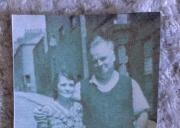
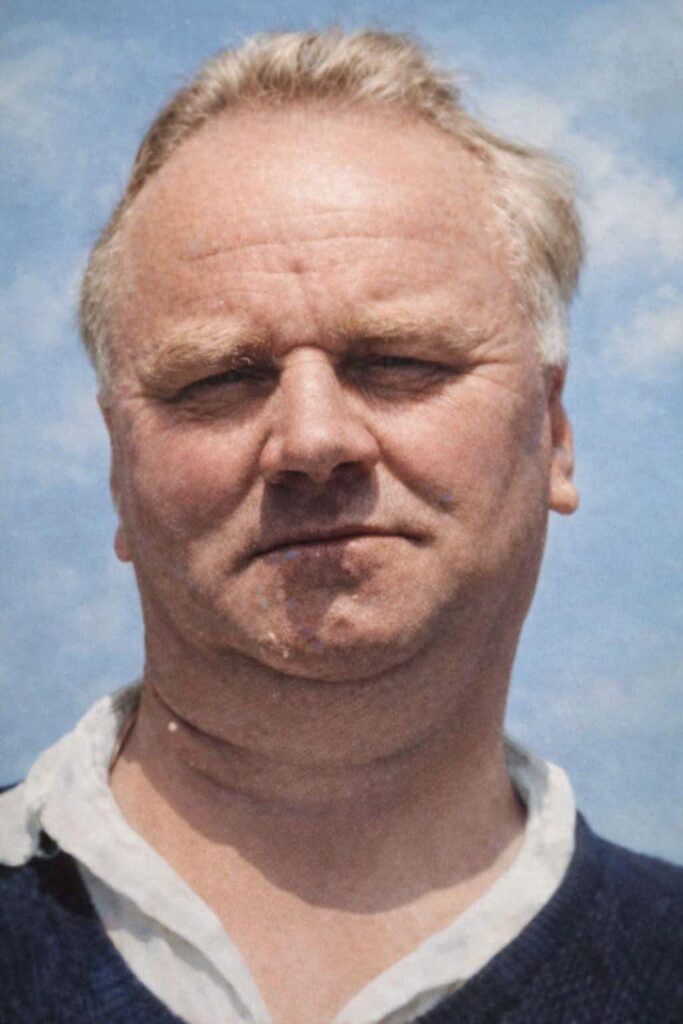
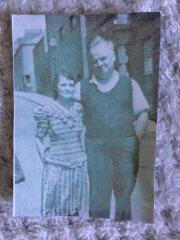
Johnny Rafferty arrived in jobs-beleaguered Maryport from Scotland in 1921, an itinerant Scottish beggar, with the town suffering during the depression years. A life-long member of the Communist Party, Johnny Rafferty was a man who firmly divided opinion; he had thousands of friends but also many enemies. Over the following 50 years, until his death in 1971, he put his indelible stamp on the community.
Rafferty had an affliction of the foot, which affected his walking. When he first arrived in Maryport, he would play a melodeon on street corners for pennies & he had a little dog which used to sit up & beg for him on market days. He stayed at a local lodging house, which is where he met a local girl, Mary, who subsequently became his wife, & he settled into the town. Johnny was the very epitome of the ‘common man’; he never wore a tie & preferred collarless shirts. Mary provided steadfast support.
It is hard to imagine the industrial landscape of Maryport prior to the 1930’s. Mining, shipbuilding, a busy railway, an iron foundry, the docks, fishing……….at one time the town must have echoed with the noise & bustle of activity. The collapse of industry in the early part of the 20th century impacted badly on Maryport. Conditions in Maryport in the early 1930’s were shocking, & unemployment peaked at 97%, with most people having no hope of finding any kind of work. Rafferty was involved in fighting against the means test, a harsh government financial check introduced in 1931 during the Great Depression, where officials inspected household incomes, forced families to sell personal belongings or use up savings, and denied or reduced the “dole” unemployment benefit if anyone in the home earned any money. He set up the National Union of Unemployed Workers in Maryport, organising hunger marches & helping fight for people’s rights.
Rafferty became leader of the Maryport branch of the Communist Party & showed a strong commitment to fighting for the underdog. He joined with others of a left-wing political disposition, such as John & Jimmy McCarron, & ‘Fritz Davidson’, in opposing Oswald Mosley’s ‘Blackshirts’ from the British Union of Fascists at the opposite side of the political spectrum. They would travel to Carlisle & Newcastle to disrupt Blackshirt meetings. Rafferty’s disability meant he couldn’t run as fast as the others when the Blackshirt ‘heavies’ chased them. Once nearly caught, he had his overcoat torn from his back, but he loved the battle with the fascists.
Rafferty gave his support to the means tested claims of Maryport families & won concessions in areas where others dare not intervene. As a result, he had a huge local following & became a folk hero in the area. He organised the Maryport marchers in their contribution to the Jarrow March of October 1936, protesting against poverty & unemployment, & it is said that he shed tears because his foot affliction meant that he could not lead them.
In February 1935, when poverty was at its height, there was a delay in paying out two shillings, (10p), family coal allowance. Led by Rafferty, some 1,000 people gathered in Fleming Square outside the Maryport Relief Office, where Rafferty demanded a deputation. At the time, the Mid-Cumberland Electricity Company was installing electricity cables & had recently dug a trench across the square, resulting in cobble stones piled in heaps. Suddenly, two stones were thrown at the police guarding the premises & within a minute cobbles were being hurled in volleys. Staff inside had to take refuge away from the windows being smashed & the police called for reinforcements. Following the arrival of extra police, the crowd eventually dispersed, but later in the evening, Johnny Rafferty & James McCarron were arrested & charged with assaulting the police. The tension in Maryport was so strained that only one magistrate could be found to sit & remand them, that being Mr Thomas Carey, then 102 years old, of Curzon Street, Maryport. Mr Carey walked to the court, sat with his ear trumpet, & not unwisely, remanded the two men on bail.
When the trial was held, James McCarron was defended by a Barrister employed by the Council of Civil Liberties; Rafferty defended himself. Expecting trouble, policemen were drafted to Maryport from across the area & while one hundred hid in the old Court House in Fleming Square, others sealed off the police court end of Eaglesfield Street. Some 4,000 demonstrators marched in ranks of four, bearing both red and hammer & sickle banners. Having marched past the Priory, the leaders continued straight towards the police, but turned down Crosby Street when it appeared batons would be used. Three times the demonstrators marched the route until the court made its decision. The court found no evidence that Rafferty or McCarron had thrown a cobble or struck a policeman & they were acquitted, following which the men were carried around the town by the cheering marchers.
Whilst Rafferty was said to hate publicity, he was instrumental in focusing national attention on unemployment & was a major factor in the appointment of the first special commissioner to address the problems of the area, where the unemployment rate was much higher than the likes of Jarrow & Merthyr Tydfil.
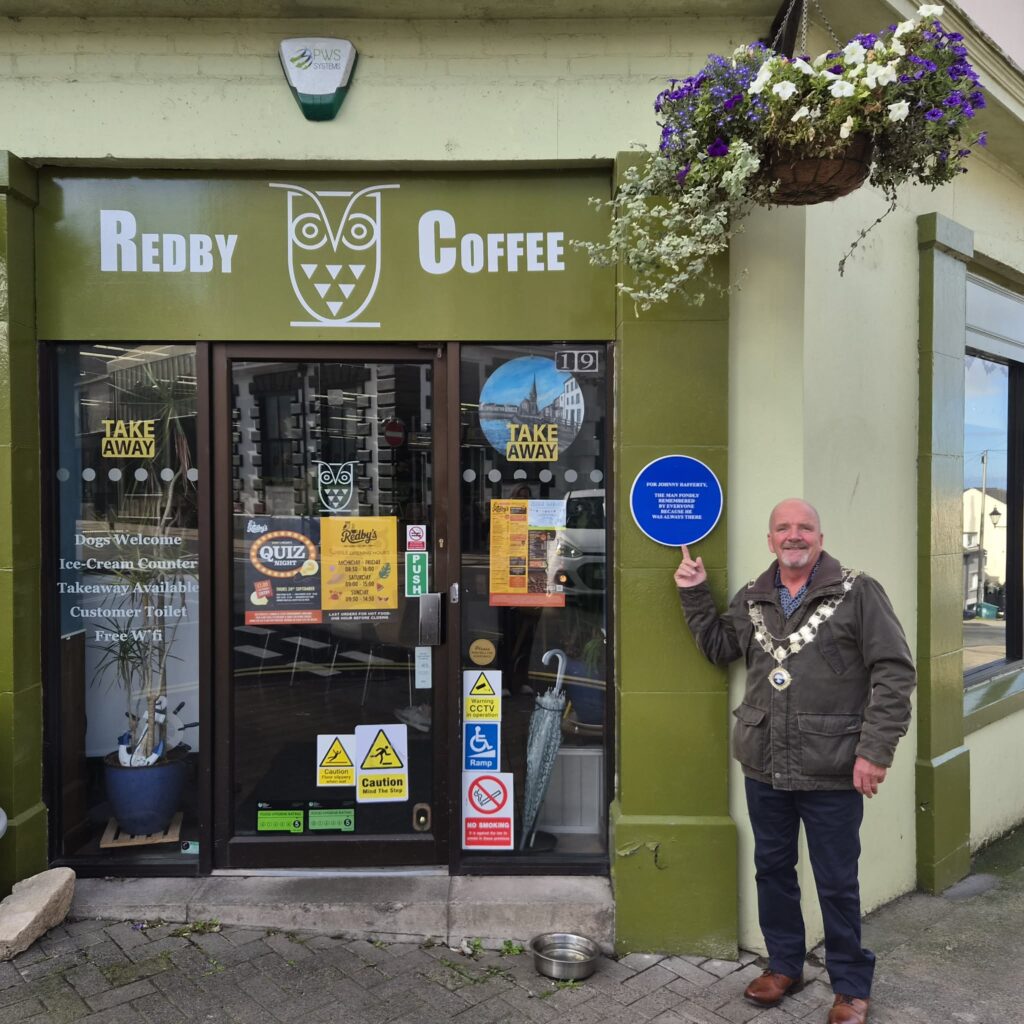
With the backing of local subscriptions, including pennies collected from people in the dole queue who were incredibly supportive with their meagre resources at a time when Maryport’s level of unemployment ranged between 75% & 85%, Rafferty turned John Hardy’s chemist shop on the corner of High Street & Senhouse Street, (the site of Redby Coffee today), into the unlicensed Unemployed Workers Movement Club, where the unemployed could play games such as darts, dominoes & cards all day, watch films & play bingo, with a mug of oxo, & it became a very busy place. When the Second World war came & unemployment all but disappeared, Rafferty took over the premises himself under the name of the West Cumberland Social Clubs Ltd. Cheap meals were provided for those in need, & cheap sweets for children, although some children were told, ‘don’t step on the pavement near Rafferty’s Corner’ & for some it was a place of ill repute. The corner is still known to some today as Rafferty’s.
Rafferty was the first in the area to install gaming machines, which led to him becoming one of the richest men in Maryport, but his financial success gave rise to envy, & there were protests against his pro-Russian views. From one attack, he is said to have defended the café with a cavalry sword, & at another, petrol bombs were thrown. However, when the Nazis invaded Russia, things changed, & West Cumberland Clubs became a place where servicemen could get a meal, a bath & a bed, all provided free of charge. Rafferty also ran the Maryport Exchange & Mart. He would buy anything a person didn’t want & sell anything a person wanted that he had. Rafferty’s children’s parties at the former Palace Ballroom on Lower Church Street were famous, & he was noted for providing pensioners with three course meals for two shillings, (10p), at his café, & sending out free meals to the elderly who were too sick to go to the café.
Johnny Rafferty went on to become the only communist to serve on Maryport Urban District Council, which he did for three years before the Second World War, but because of the war, his term lasted ten years, before being defeated in the 1946 elections. In 1957, he devised a plan for the disused docks & harbour as a super caravan town, boat & pleasure marina, with housing & a working dock, & a model was displayed in the window of his club, asking for local comment & support. In what must have been a great blow to Rafferty, the County Council Planning Department turned it down in favour of other proposals. How might things have been if it had been given approval?!
Rafferty bought the property, ‘Ridgemount’, which was the smaller of two properties built for the Maryport Shipbuilding family, the Ritsons, situated at the junction of Church Street & Fleming Street. After its acquisition, he turned it into flats, occupied one & let the others at a time when housing accommodation was acutely short. His granddaughter Mary recalls the grandeur of the building, with a beautiful marble staircase, crystal chandeliers & an Adams fireplace; sadly, the building no longer exhibits such style.
As a communist, Rafferty was honoured to be invited to Russia & he & his family attended one of the May Day parades in the post-war period. True to his beliefs, during elections, he would support those with left-wing leanings through the use of his vehicle. He would always talk of the days when he campaigned for people’s rights & expressed his sadness that such support was still needed. Johnny’s wife Mary was a small but vocal supporter of her husband’s views. She is remembered by Councillor Carni McCarron Holmes for ‘trashing’ an election meeting held at the Freemasons’ Hall by regularly screaming, ‘what about the workers?’. At three years old, Carni recalls being very frightened of this small & very vocal lady!
When the first carnival was held in Maryport in 1971, organised by Councillor Carni McCarron Holmes, she recalls asking him for a donation, & he agreed that if £50 could be raised, he would match it, & he remained true to his word, as well as providing a large trophy for the carnival. When he died that year, the funeral attracted mourners from across the country, mostly communist sympathisers, but it is said that half of the town stood on their doorsteps to salute the funeral cortege as it passed through the town.
In 1992, a play depicting Johnny Rafferty’s life was made. Entitled ‘Rafferty’s Café’, it was promoted as one man’s rise to power in a struggling community. Whilst Rafferty made enemies in his life, he had many, many friends. He was a complex man, sometimes sad & bitter, but in the eyes of many who remember him, a hero. In recognition of his contribution to the town of Maryport, the Town Council has installed a blue plaque at the site of his premises on Senhouse Street.
The Council is indebted to the following for the provision of information used in the development of this record:
Mary Robinson, granddaughter of Johnny Rafferty
Jim O’Rourke, Castle Hill Trust
Councillor Carni McCarron Holmes